Turntables are the cleanest way to rotate cartons, totes, crates, and pallets through 90°, 180°, 270° or 360° without forcing awkward layout compromises. When you need direction changes, merges, or transfers inside tight floor space, Turntables do the job with less manual handling, fewer bottlenecks, and a better chance of keeping people and products intact.
We design and custom manufacture conveyors and rollers to suit your load, throughput, and operating environment, then support you with spares and practical maintenance guidance.
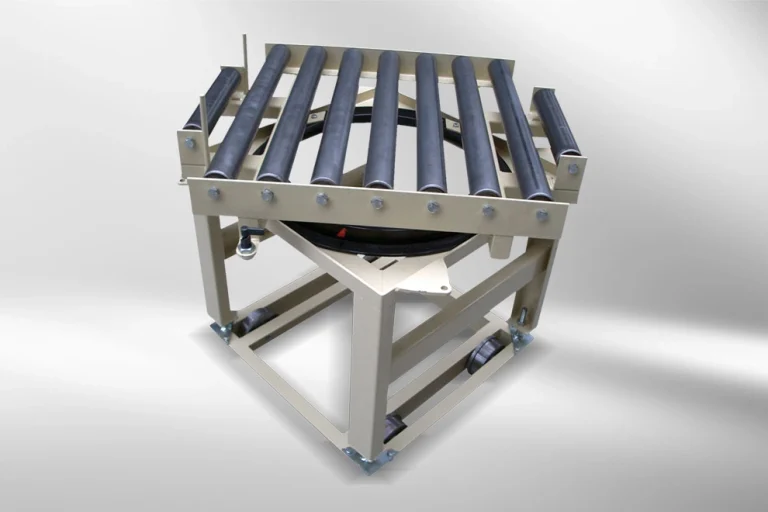
Hero media: rotating accessory solutions for directional changes, merges, and cleaner routing.
A turntable conveyor is a rotating platform installed within a conveyor line. Product transfers onto the platform, the deck rotates to a new direction, and the load transfers onto the next conveyor. Simple concept, huge impact. In most facilities, direction changes are where flow gets messy. Turntables solve that mess by creating a controlled rotation point that protects product stability, improves layout efficiency, and reduces the manual repositioning that quietly steals time.
In practical terms, Turntables are installed between belt conveyors, gravity roller lines, and powered roller systems. They are especially useful when you need to route product around fixed infrastructure, create compact U-shapes, join lanes, or feed a packaging line without long extra conveyor runs. If your goal is consistent throughput and safer handling, Turntables typically offer a cleaner solution than forcing tight curves or relying on repeated “pick it up and turn it” operations.
This aligns with broader material handling basics: reduce touches, reduce risk, reduce wasted motion, and keep flow predictable.
A typical installation places the rotating platform between an infeed conveyor and one or more outfeed conveyors. Loads transfer onto the deck (roller-top or belt-top depending on your application). The platform rotates to align with the required outfeed direction. Once aligned, the load transfers off, and the unit returns to default or queues the next rotation.
For higher throughput, sensors and PLC logic can coordinate stops, rotation commands, and outfeed clearance. In these setups, Turntables become a routing node rather than a simple accessory. When done properly, you get consistent transfers, fewer jams, and fewer surprise bottlenecks that appear whenever someone looks away for thirty seconds.
In many facilities, the real benefit is stability. Loads tend to misbehave at transfer points. A stable rotation deck, correct height alignment, and properly planned accumulation reduce toppled cartons and crushed packaging. That is why we engineer Turntables as part of the wider system, not as a bolt-on afterthought.
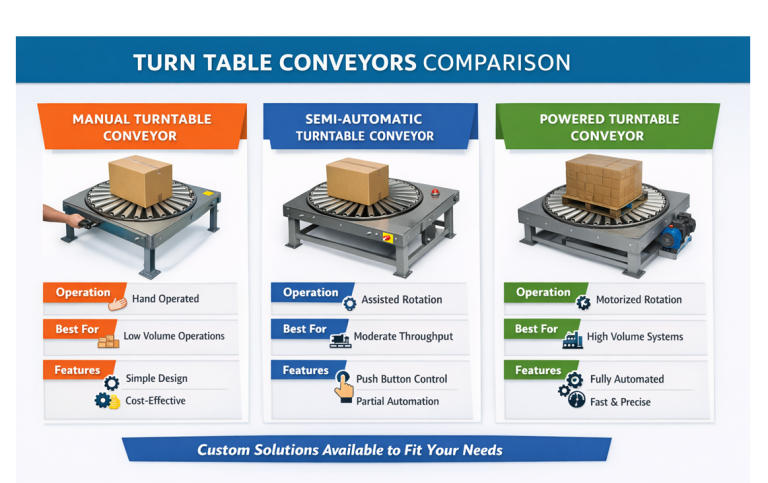
Not every facility needs automation, and not every facility can safely rely on hand rotation. We build Turntables around the variables that actually matter: load weight, product footprint, throughput, rotation angle, and how consistently upstream and downstream conveyors behave. Below are common configurations, then we refine based on your line.
Manual is effective when loads are manageable and rotation frequency is reasonable. If it becomes constant, it turns into fatigue, mistakes, and “why is this damaged?”
Assisted rotation is often the smart step when volume is growing but full automation is not yet justified.
Motorised is for when throughput targets are serious and downtime costs more than equipment.
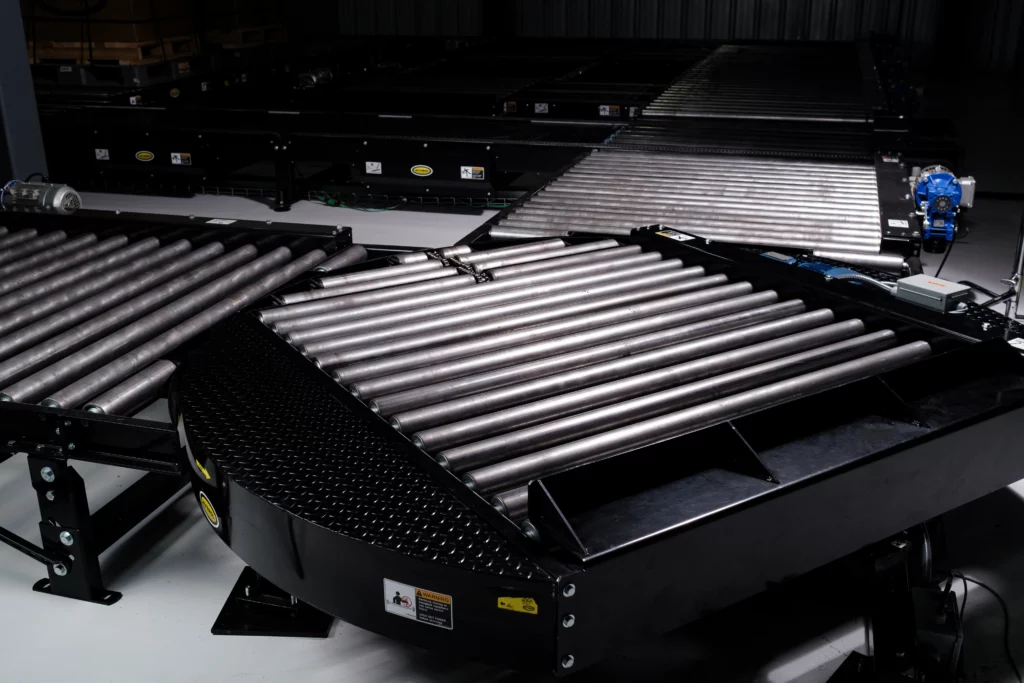
In each case, Turntables can be supplied with roller tops (cartons, totes, crates) or belt tops (where stability needs more control). Rotation can be fixed-index (90° and 180°) or set for multiple indexed positions depending on routing logic and available outfeeds.
Reliability is not one big feature. It is a series of correct decisions: stable frames, sensible bearings, predictable drive components, accessible maintenance points, and a transfer surface that matches the product. We design Turntables with those decisions in mind, because “it looked good on the quote” is not a maintenance plan.
In wash-down or corrosion-aware environments, material selection is the difference between long life and early regret.
Automation works best when sensors, stop gates, and accumulation are planned as one flow.
Most importantly, Turntables should not be treated as isolated accessories. They are a functional node inside your system. That means we evaluate upstream accumulation, downstream clearing time, and how product behaves during rotation so you do not inherit jams and misalignment from “just one rotating table.”
Turntables reduce bottlenecks by making direction changes controlled and repeatable. Instead of awkward manual repositioning, flow stays consistent and predictable.
Tight layouts benefit when Turntables replace long detours. You redirect flow without adding metres of conveyor that nobody has space, patience, or budget to maintain.
Every time a person lifts, twists, or drags a load, risk rises. Turntables reduce manual touches and improve safety by keeping movement on the system.
There is also the quiet win: less product damage. Stable rotation reduces crushed corners, torn shrink-wrap, and toppled loads that cause rework. Over time, Turntables tend to pay back by protecting throughput and reducing wasted handling time.
Because these units can be built as part of broader turntable conveyor systems, they also help simplify routing logic. Instead of building overly complex merges and diverters, you can rotate and feed the next lane in a controlled way. For many operations, that means fewer components, fewer failure points, and faster fault-finding when something does go wrong.
Use this as a baseline. Then we refine it based on your real load, cycle time, and how consistent infeed/outfeed conditions are.
| Conveyor Type | Operation | Best For | Key Features | Typical Applications |
|---|---|---|---|---|
| manual turntable conveyor | Hand operated rotation | Low volume operations | Simple design, cost-effective, no power required | Small warehouses, packing stations, low-volume lines |
| industrial turntable conveyor (assisted) | Assisted / push-button rotation | Moderate throughput | Controlled rotation, improved consistency, reduced strain | Sorting lines, assembly areas, mixed product flow |
| motorised turntable conveyor | Powered rotation | High-volume systems | Precise indexing, sensor integration, heavy-load handling | Distribution centres, automated routing, higher cycle rates |
In real-world projects, selection often comes down to two things: load and frequency. If loads are heavy or rotation is constant, powered solutions become the practical choice. If loads are lighter and rotation is occasional, manual or assisted approaches can be efficient and safe. The goal is to match the solution to your operating reality, not to your wish list.
We build to specification. Typical ranges are below. Final sizing depends on product footprint, load distribution, transfer method, and how you want the rotation cycle to run.
| Specification | Custom Options |
|---|---|
| Deck diameter | 800 mm – 3000 mm (custom sizes available) |
| Load capacity | Up to 2,000 kg (application dependent) |
| Rotation angles | 90°, 180°, 270°, 360° (indexed stops or multi-position) |
| Rotation type | Manual, assisted, or motorised |
| Integration | Belt conveyors & roller conveyors |
| Frame material | Mild steel, galvanised, stainless options |
| Controls | Sensors, VSD, PLC-ready control integration |
The “right” specification comes down to one question: what must the rotation point protect you from? If it is speed and volume, motorised makes sense. If it is stability, we focus on deck surface, guides, and controlled transfers. If it is tight space, we design the infeed/outfeed geometry so Turntables reduce conveyor length without creating transfer headaches.
These units work best when the surrounding system is designed as one flow. We integrate rotation platforms into complete conveyor solutions and also retrofit into existing lines when geometry allows. Common integrations include belting-driven lines, gravity roller zones, and powered roller transfers.
Explore belting options: Modular Belt, PVC Belt, PU Belt, and Fasteners.
If your product moves on rollers most of the time, a roller-top deck is often the cleanest approach.
We align rotation solutions with broader Systems layouts, supported by Parts & Spares and implementation through our Services team. We also provide custom manufacturing of conveyors and rollers to match existing lines, which is how you avoid the “nothing fits” retrofit trap.
If your operation needs a clean routing node for mixed destinations, Turntables can be paired with stop gates, accumulation zones, or simple operator prompts. This helps keep the line stable without turning it into a complicated science project. The idea is controlled motion, not complexity for its own sake.
Selection is easy when inputs are clear. Not “we think this is about…” inputs. Real numbers. Use the checklist below to get the right build faster:
When these inputs are clear, Turntables become straightforward to engineer: correct deck size for the product, correct bearing/drive design for the load, safe transfers, and controls that match your workflow. The result is predictable performance beyond commissioning day.
A rotating assembly needs maintenance. That is not drama, it is physics. The good news is that well-designed rotation equipment is straightforward to maintain when access and serviceability are planned properly.
If a site is prone to jams, we usually review accumulation and downstream clearing. The rotation point is where symptoms show, not always where causes start.
Supporting products: Rollers, Belting, and Components.
Because we focus on custom manufacturing of conveyors and rollers, our support approach is practical: keep critical wear items available, standardise where possible, and design for service access. Over time, well-supported Turntables help reduce downtime and protect throughput targets.
If you want to go a step further, we can recommend a basic spares kit aligned to your operating environment and expected duty cycle. That includes typical wear items plus any drive components that could cause extended downtime if they fail unexpectedly. This is especially valuable in regional operations where lead times matter.
You can buy a rotating platform from plenty of places. What you actually need is a unit that fits your flow, integrates correctly, and stays reliable after the installation “honeymoon.” That is why our approach is engineering-led and built around operating reality.
We custom manufacture conveyors and rollers to match your load, layout, and throughput. Turntables are built to suit the system, not forced into it.
Our solutions integrate with Conveyors, Rollers, and Belting so the full line behaves predictably.
We support systems with Services and Parts & Spares so you can maintain and scale instead of rebuilding from scratch.
If you want Turntables that are sized correctly, built properly, and supported sensibly, we will help you engineer the right solution and keep it reliable.
Conveyor Supplies Africa supports projects across South Africa and the broader region. We supply and custom manufacture conveyor systems, rollers, and Turntables for customers operating across multiple countries and industry segments (excluding mining, as requested).
If your project needs compact routing that protects product and improves flow, Turntables often become the quiet hero inside a bigger system.
Turntables rotate products within a conveyor line so items can change direction, merge, divert, or route to a new lane. Typical rotation angles include 90°, 180°, 270°, and 360°.
Manual units suit low-volume and lighter handling points. Motorised units suit higher throughput, heavier loads, and automated routing where consistent cycle time matters.
Yes. These units integrate with belt conveyors, gravity roller lines, and powered roller conveyors. Deck surface selection depends on your product and transfer requirements.
Yes. We custom manufacture conveyors and rollers, including rotation platforms, to suit diameter, load, frame material, rotation indexing, and integration requirements.
Typical diameters range from 800 mm to 3000 mm with capacities up to around 2,000 kg depending on design and application. Final sizing depends on product footprint and load distribution.
Yes. We support systems with spares aligned to the build specification and service support where required, including components across rollers, belting, and drive parts depending on configuration.
Need integration into a wider system? Start with Systems, then browse Products and our Services.
Designed for uptime, built for integration, supported for the long run.
WhatsApp us